Assay Design for Bacterial Identification and More..
AlleleID® is a comprehensive
desktop tool designed to address the challenges of bacterial
identification, pathogen
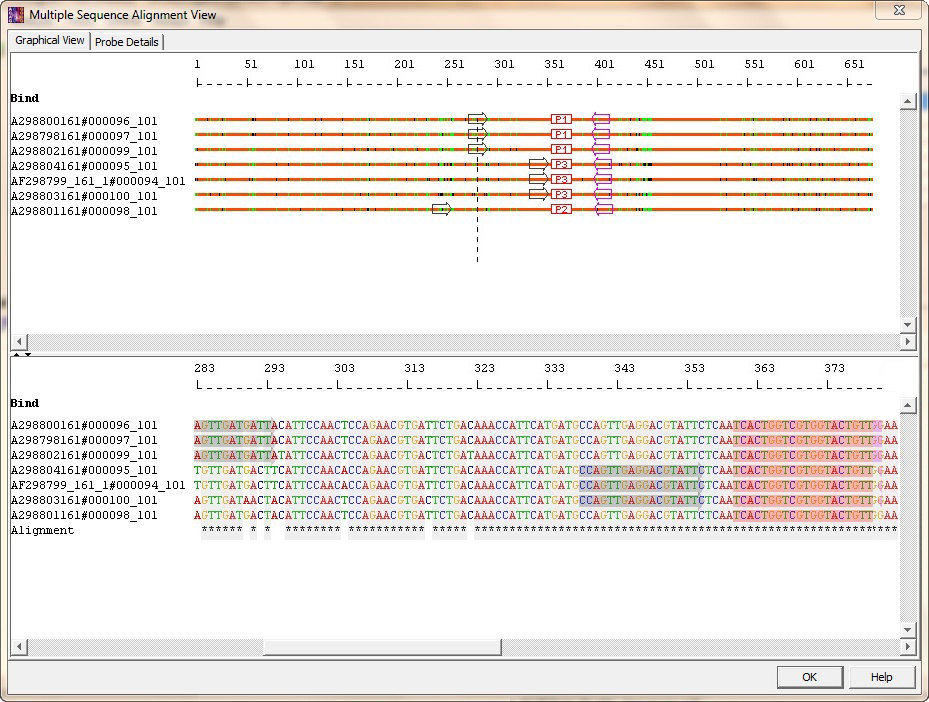
detection or species identification. With ClustalW multiple sequence
alignment at its core, AlleleID®
can be used to design species identification/cross species probes for microarrays or real time PCR including SYBR® Green, TaqMan® MGB, TaqMan® probes, Molecular Beacons
and real
time PCR primers. AlleleID® also offers support for designing microarray experiments for detecting alternative splicing events.
Species
Identification Assays/Cross Species Assays/Allele
Identification Assays
AlleleID® aligns sequences
using ClustalW and
analyzes conserved and species specific regions. You can then use the
program for real
time PCR primer design (SYBR® Green primer design included) and dual labeled probe design (TaqMan® probes, TaqMan® MGB probes and molecular beacons). These assays are designed to detect only the
strain (strain detection) or species of interest from the mix.
For cross species assays, AlleleID® identifies the conserved regions to design a universal probe. For related organisms, AlleleID® can be used to study gene expression when genome draft of the organism under study is not available. This powerful functionality is sure be helpful for many challenging tasks such as detection, identification, quantification or monitoring of contaminants, environments...
Sophisticated Algorithms for Assay Success
Highly specific oligos are designed by avoiding regions of significant homologies found by automatically interpreting BLAST search results. Real time PCR primer & probe efficiency is enhanced by avoiding template secondary structures. "Minimal Set", one of the
most innovative features in the program, helps design the fewest
number of allele specific oligonucleotide primers and dual labeled probes that
uniquely identify each of the desired species/strain/taxa from the
mix, lowering assay costs. For taxa or cross species assays, this feature is especially useful when the group or taxa is
highly dissimilar. For a partial set of pre-designed, proven set of
primers, AlleleID® can design compatible primers and probes for the
rest of sequences for species identification or taxa specific
assays.
Extensive Support
for Real Time or Quantitative PCR Assays & SNP/Expression
Microarrays
AlleleID® designs optimal SYBR® Green primers, TaqMan® probes, TaqMan®
Minor Groove Binding (MGB) probes, FRET probes or molecular
beacons for real time quantitative PCR differential gene expression
and SNP genotyping assays. You can also design real time PCR primers
and dual labeled probes for up to ten thousand sequences in a single run for making SNP
detection or expression microarrays.
Design Luminex xMAP® Assays
AlleleID® designs strain differentiation multiplex assays for Suspension Array systems based on Luminex's xMAP® technology. If you are working with closely related organisms, this functionality will enable you to run Allele Specific Primer Extension (ASPE) and DHA assays in a single reaction vessel.
Multiplex Ligation-dependent Probe Amplification (MLPA) Assays for Copy Number and Mutation Detection
AlleleID® is the only program that designs synthetic probes for MLPA or Multiplex Ligation-dependent Probe Amplification technique introduced by MRC Holland enabling the researcher to extend the technique when appropriate kits are unavailable. It is a rapidly growing high throughput method for genetic profiling. It can detect exon deletions, copy number changes, and CpG methylation patterns. It is cost-effective, sensitive, specific and reproducible.
AlleleID® also designs mRNA specific, DNA specific and mutation specific MLPA probes for PamGene Arrays. This will enable PamChip® users designing their own probes to detect genes of interest using PamGene's high precision detection platform. Combining these two technologies, copy number changes and mutation can be easily detected in just 6 hours.
Please browse through the feature list of AlleleID® to learn more about what the program can
do for you. To give you a quick start, we have prepared a multimedia
tutorial. It steps you through each function of the program.
|